Is PSIRA a Government or Private Entity? The Complete Answer


 July 24, 2026 6:37 am
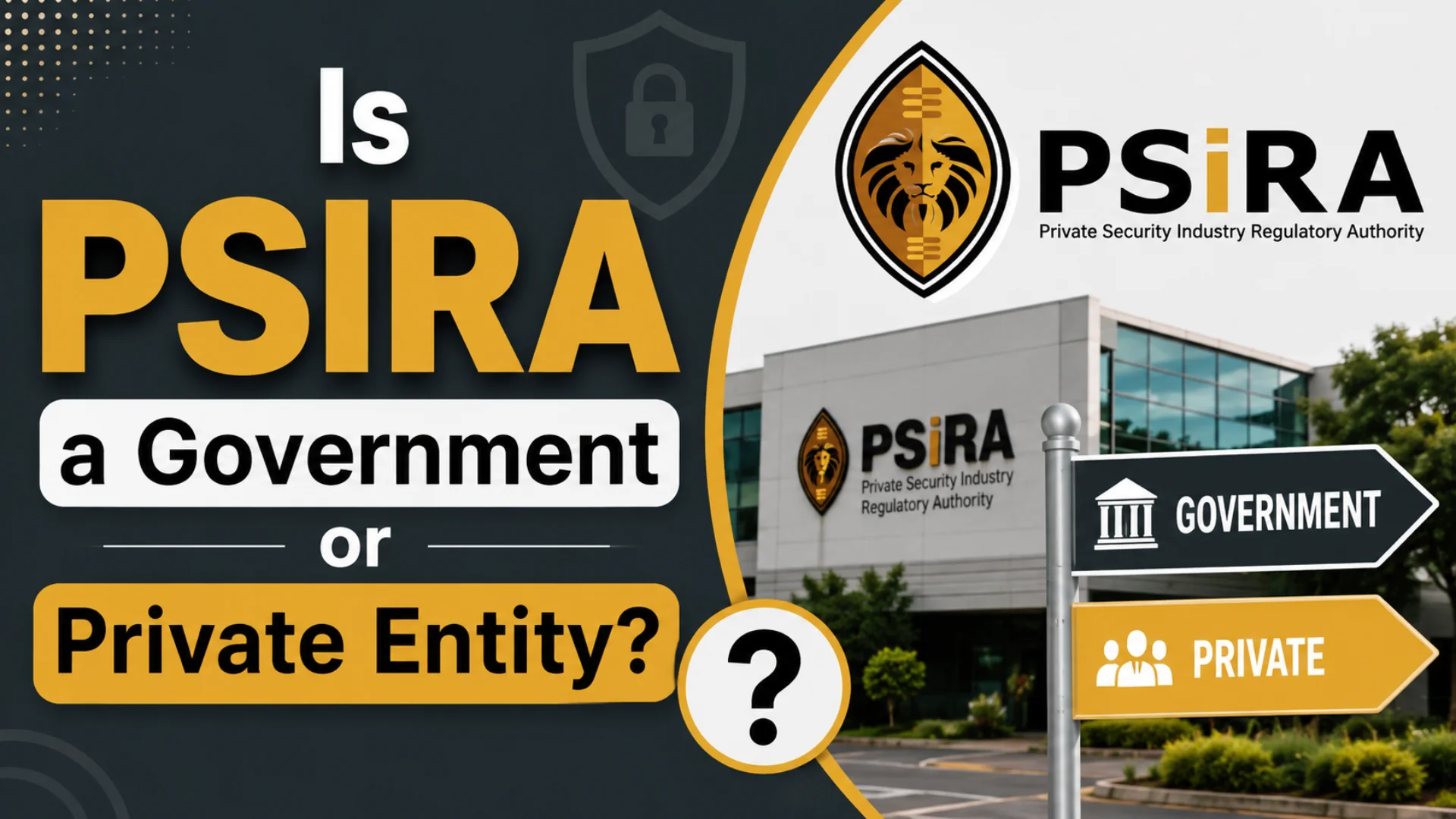
If you work in South Africa’s security industry or you’re hiring a guarding company, you’ve probably come across the acronym PSIRA more times than you can count. Yet one question keeps popping up in forums, WhatsApp groups, and Google searches alike: is PSIRA a government body or a private organization?
The short answer is that PSIRA is a government entity, not a private company. But the full picture, how it was created, who it answers to, and why that distinction actually matters to security officers and businesses, deserves a closer look. This article breaks down exactly where PSIRA fits into South Africa’s regulatory landscape, based on its founding legislation and current official mandate.
PSIRA Is a Statutory Government Body
PSIRA is what’s known as a statutory body, an organization created directly by an Act of Parliament to carry out a specific public function. This places it firmly within the structure of South African government, alongside similar regulators created to oversee specific industries.
Here’s what confirms its government status:
- Legislative origin: PSIRA exists because Parliament passed a law creating it, not because private investors founded a company.
- Reporting line: PSIRA falls under South Africa’s Department of Police and reports to the Minister of Police, placing it within the country’s security and justice governance structure.
- Public mandate: Its objective is explicitly framed as serving the public and national interest by regulating security providers “in the public and national interest,” as stated in its founding Act, not generating profit for shareholders.
- Regulatory powers: PSIRA can license, suspend, deregister, and even pursue prosecution against non-compliant security officers or companies. These are enforcement powers that only a government-mandated authority holds; no private company has this legal reach over an entire industry.
In short, PSIRA operates much like other South African statutory regulators bodies that sit outside a government department’s day-to-day operations but remain accountable to a government ministry and empowered by national legislation.
Why the Confusion Exists
Three things commonly trip people up:
- The name itself. “Private Security Industry Regulatory Authority” contains the word “private,” so people assume PSIRA must be a private organization. In reality, it regulates the private security industry it isn’t part of it.
- Registration fees. Because PSIRA charges security officers and companies for registration, renewal, and compliance certificates, some assume it must be a commercially run private enterprise. Fee-based funding is common among statutory regulators worldwide and doesn’t change their government status.
- Operational independence. PSIRA runs its own council, CEO, and administrative structure rather than being staffed by police officers or civil servants in the traditional sense. This operational independence is typical of statutory bodies and doesn’t make them private.
Why This Distinction Actually Matters
Understanding that PSIRA is a government-mandated authority, not a private company, has real, practical consequences:
- Legal compliance is mandatory, not optional. Every security officer and every security business in South Africa is legally required to register with PSIRA before providing services. This isn’t a membership you can opt out of the way you might skip a private trade association.
- PSIRA decisions carry legal weight. When PSIRA suspends a registration or pursues disciplinary action, it is exercising statutory authority, similar to how a professional council (such as those regulating doctors or lawyers) enforces standards within its sector.
- Accountability runs to government, not shareholders. Because PSIRA answers to the minister of police and Parliament, it is subject to public accountability mechanisms, parliamentary oversight, auditing, and public reporting that a private company would not face in the same way.
- Verification and trust. Because PSIRA is a public authority, its registration database serves as a credible, government-backed way for the public to confirm whether a security company or officer is legitimately licensed to operate.
PSIRA’s Core Functions at a Glance
To put PSIRA’s government role into context, here’s what it actually does day to day:
- Registers and grades security officers, from entry-level Grade E up to senior Grade A
- Licenses private security businesses and training providers
- Investigates complaints and enforces the industry’s code of conduct
- Suspends or withdraws registrations for non-compliance
- Monitors an industry that, per capita, is one of the largest in the world, with active private security officers outnumbering the combined strength of South Africa’s police and defence force
A Note on Accountability and Recent Scrutiny
Like any public institution, PSIRA is not immune to internal challenges. In late 2025, several PSIRA officials were suspended following irregularities uncovered in the registration of a private security company. While incidents like this draw scrutiny, they also illustrate the point: PSIRA is accountable to public oversight processes precisely because it is a government entity, not a private business answerable only to its own board.
Conclusion
To directly answer the question: PSIRA is a government entity, not a private company. It was created by an Act of Parliament, operates under the authority of the Civilian Secretariat for Police Service and the Ministry of Police, and exercises statutory regulatory powers over South Africa’s entire private security industry. The word “private” in its name describes the industry it oversees, not its own institutional identity.
For anyone working in or hiring from the security sector, this matters. Registration with PSIRA isn’t a private-sector formality; it’s a legal requirement backed by national legislation, and PSIRA’s decisions carry the weight of a government regulatory authority.
zukiswa wanner
I'm Zukiswa Wanner, the administrator of PSiRA Verification. I share accurate, practical guidance on PSiRA registration, verification, renewals, and compliance to help South Africans confidently access trusted information.